Microduck: A Little Walking Robot You Can Teach
At a glance
Three things tell you if it fits
- What it is
A 25 cm biped from Pollen Robotics, Hugging Face’s robotics team, with 15 motors and an open software stack.
- Best fit
Curious makers, robotics learners and developers who enjoy trying, adjusting and trying again.
- Know this first
Preorder, not ready-to-ship stock. Built-in play needs no coding; teaching new skills does. Age guidance is not finalized.
Pollen’s introductory U.S. preorder price was $399 before tax and shipping on October 29, 2026. Currency and the final total depend on destination. Direct manufacturer link, not an affiliate link.
Open the full guideHow it works · use cases · important limits
The fun is making a small machine move
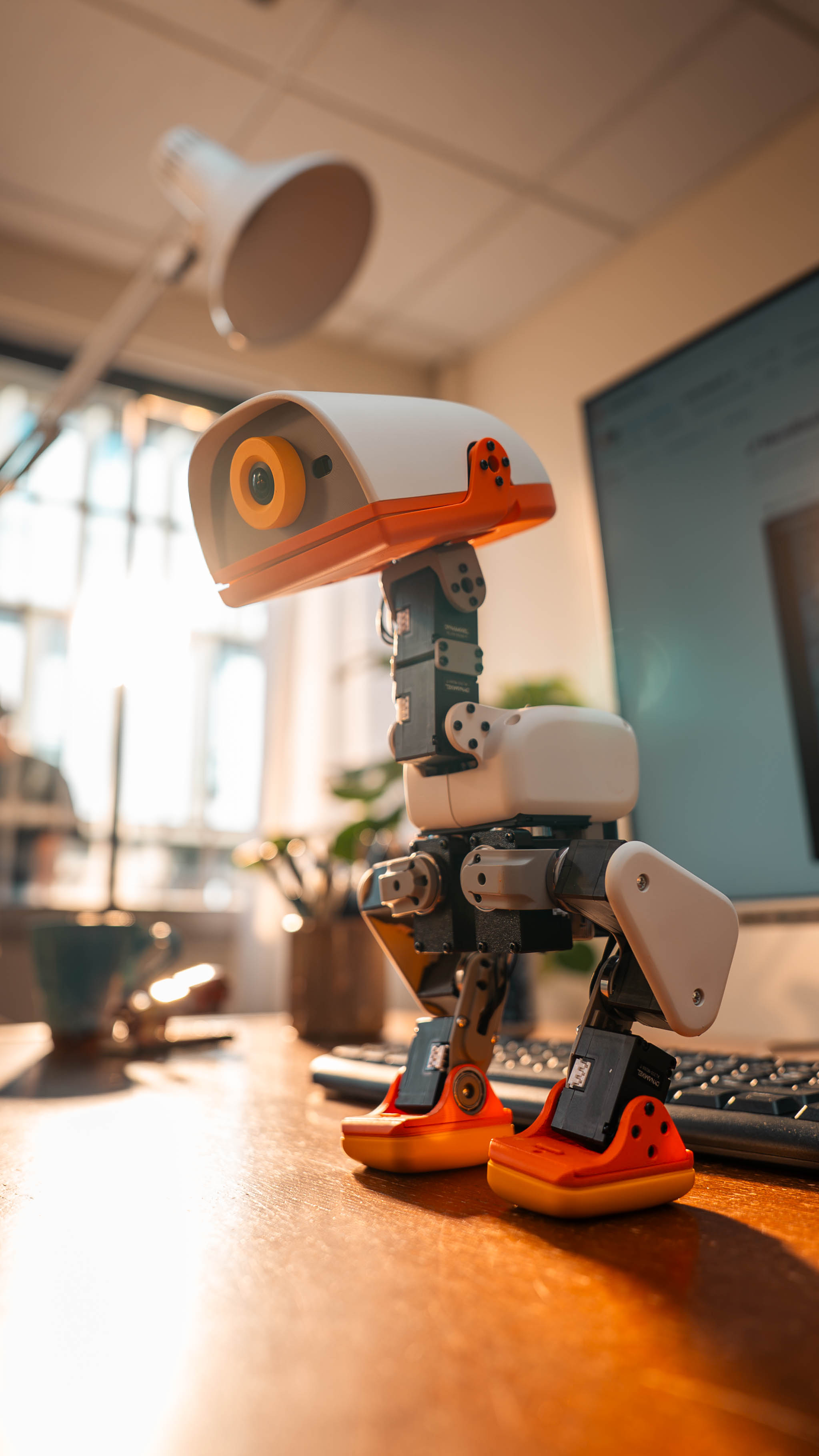
Move a joystick and a little duck-shaped robot waddles across the floor. Microduck lets you start with ready-made moves, then experiment with how a real robot learns to balance and walk.
A remote-controlled walk is the easy starting point. Pollen also describes sitting, crouching, kicking, grasping with the beak and recovery from many common falls. The appeal is seeing a movement you can change happen on the floor, beyond a simulation on your screen.
The base package lists the robot, battery, USB-C cable and game controller.
Robot software and simulation tools let developers change and train behaviors.
Roller attachments, a ball and a laser pointer are listed in a separate accessory pack.
Ready-made moves and new skills are different jobs
You do not need to train walking from scratch to enjoy the supplied behaviors. Pollen describes gamepad control and reactions such as following a laser dot. Roller skating requires the roller attachments; a launch demonstration does not make every prop part of the base box.
For a new skill, you set up the software, define the task, train and test a behavior in simulation, then check it on the robot. Reinforcement learning means rewarding useful actions during repeated trials. Moving that result onto real hardware still takes tuning: a simulated floor and your floor are not identical.
Why NVIDIA appears in the story
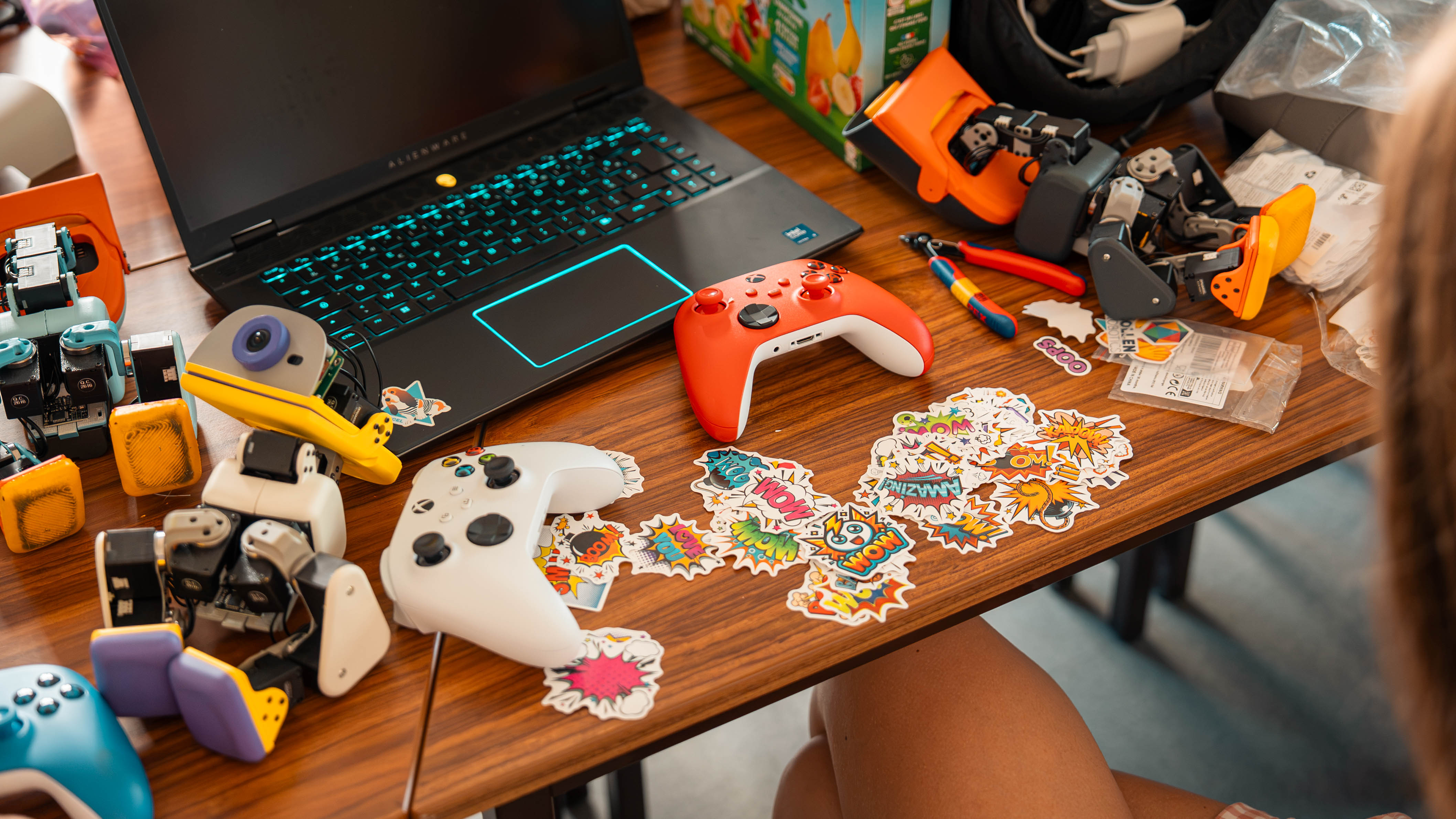
NVIDIA’s October 23 article uses Microduck to explain an AI-assisted robotics workflow with Isaac Sim and Isaac Lab: build a virtual obstacle course, train movement and evaluate it before physical deployment. That is a simulation and training connection. The robot’s maker is Pollen Robotics; its listed onboard processor is a Rockchip RK3566. NVIDIA’s demonstration is not a promise that every showcased task ships ready to use.
A creature to experiment with, not a household helper
The camera and depth sensor help the robot observe its surroundings, while motion sensors track its body and head. Pollen describes communication through sounds rather than spoken conversation. These are tools for movement experiments; reliable household chores are not an established capability.
Allow clear space for movement and falls, and follow the eventual safety instructions. The maker estimates roughly an hour of battery use, depending on activity. Its age recommendation and several sensor details remain provisional; the duck shape should not be read as certification for a small child’s toy.
Preorder delivery timing
On October 30, 2026, Pollen’s U.S. store said current preorders were expected to ship after April 2027, in order received. This is an estimated shipping window, not a guaranteed arrival date. The earlier before-Christmas-2026 target concerned the first deliveries. Listed launch destinations include the US, Canada, the EU, the UK, Norway, Switzerland, Japan and South Korea.
The software is open source; the mechanical and electronics design files are not freely released under that description. Some SDK and camera details remain provisional.
Controlling it, then developing new moves
The included controller and built-in moves provide a starting point. New behaviors involve software setup, simulation and testing on the physical robot. That mix of play and development is the appeal for people interested in learning how a small biped moves.
The product and development descriptions come from Pollen Robotics and NVIDIA’s October 2026 technical article. Microduck is a preorder product; long-term owner experiences are not available in the cited material.
Models to compare
Microduck and the included controller
PLAY + ROBOTICS DEVELOPMENT
Pollen Robotics Microduck
Microduck · programmable biped · preorderStart with the included controller and built-in moves; develop new behaviors with its open software tools.
Makers and developers who want a small physical platform for movement experiments.
See details · features, conditions and sources
Key features
- Size
- 25 cm tall · under 800 g
- Movement
- 15 motors · articulated legs, head, neck and grasping beak
- Base box
- Robot, battery, USB-C cable, controller
- Battery estimate
- About one hour depending on use; removable battery
- Colors
- Cream, Graphite, Lavender, Sky · same core robot
Before you buy
- The maker’s introductory preorder price is US$399 before taxes and shipping. The delivered total varies by destination.
- Current preorders have a future estimated shipping window. Final age guidance and software requirements remain relevant to its use.
Sources
- Pollen Robotics · Microduck and package contents · checked Oct 29, 2026
- Pollen Robotics · Meet Microduck · built-in behaviors and development
- Pollen Robotics · press kit, provisional specifications and photographs
- Pollen Robotics store · exact Microduck preorder and shipping markets
- NVIDIA · Microduck simulation and training workflow · Oct 23, 2026
As an Amazon Associate, we earn from qualifying purchases.
Amazon and the Amazon logo are trademarks of Amazon.com, Inc. or its affiliates.